April 21, 2026
Story by Natalie Kientzy, chscommunications@missouri.edu
Navigating unfamiliar environments can be challenging, especially for individuals who are blind or have vision impairments. Mizzou Occupational Therapy students recently completed a pilot project that tested accessibility-focused technology in Lewis and Clark halls, exploring how evolving tools can help create more inclusive spaces on campus and beyond.
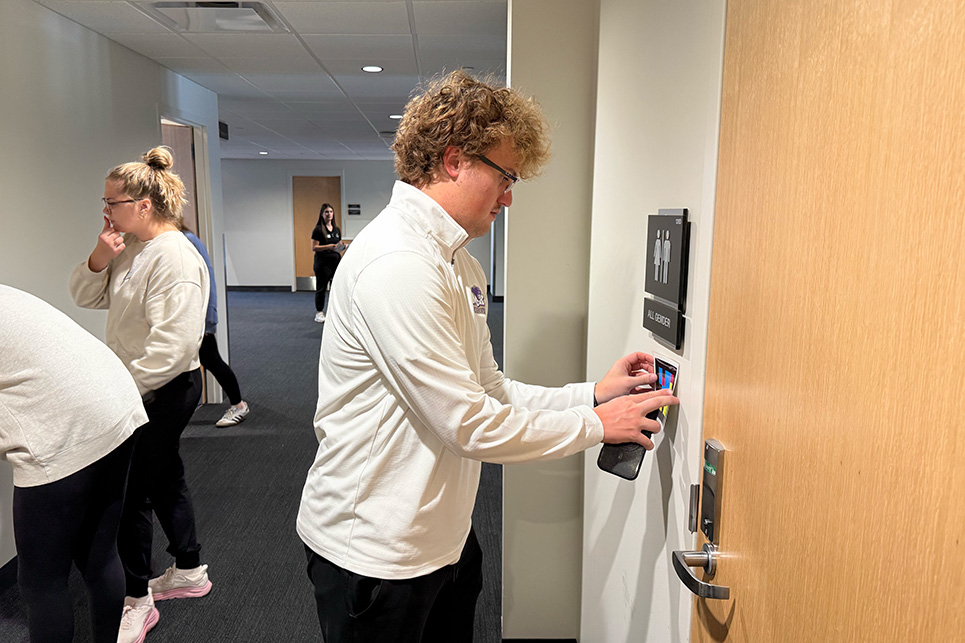
NaviLens uses scannable codes similar to QR codes but built with accessibility in mind. The codes are detectable from up to 15 feet away and can be read in any light condition. The app also translates information into more than 30 languages, offering support for non-English speakers.
Developed in Europe, NaviLens is widely used in hospitals, transit systems and on food packaging from brands like Coca-Cola and Kellogg’s.
In an effort to bring the technology to Columbia, Patrick Lee, executive director of the local Services for Independent Living, partnered with the Department of Occupational Therapy at Mizzou. Faculty members Lea Ann Lowery and Katelyn Mwangi teach a course that pairs students with community programs to promote health and wellness for individuals with disabilities and other populations that occupational therapists encounter.
“We really want students to understand that being an occupational therapist can expand beyond a hospital setting or an outpatient clinic,” Lowery said.
Partnering with Lee to pilot NaviLens offered a chance to bring occupational therapy into the community and support people with disabilities and language barriers as they navigate everyday spaces.
While the students were excited to introduce the technology on campus, they initially struggled to find a site to implement the codes.
“It was hard to get a buy-in,” said second-year occupational therapy student Caleb Kickham. “People were worried about the cost and didn’t want to pay for something that may not be used long-term. But we mentioned it to Stephanie Reid-Arndt, the senior associate dean of the college, and she was very willing to let us trial the technology in the lobby.”
The students methodically measured and mapped the Clark Hall lobby to determine where codes should be placed. They then programmed the message each code would send to NaviLens users.
“It was a lot harder than it seems to make sure you’re wording things right and helping someone feel oriented without seeing their surroundings,” said Maya Broshears, a second-year occupational therapy student. “It definitely took some adjusting to make sure everything was working as it should be.”
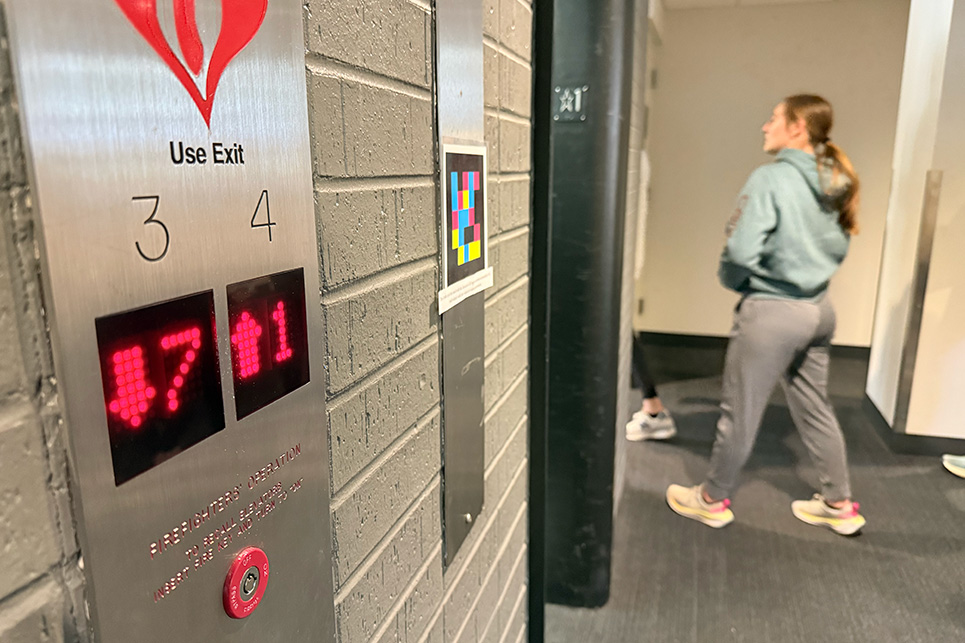
According to Broshears, it was these specific challenges that provided additional insight into the challenges faced by individuals with vision impairments.
“We discovered how complex community spaces can be,” she said. “Many places have environmental set-ups that move and change, which can make it harder to learn how to navigate.”
While the pilot project was underway, the OT students were pleased to see students, professors and other visitors interacting with the NaviLens codes and reading the signage. Initial feedback from the trial was largely positive, with users reporting that the technology was easy to download and use, citing the app’s customizable voice reading settings and ability to register codes from far distances.
With the pilot complete, students and faculty hope the trial will spark broader conversations about accessibility across campus and encourage other community partners to explore inclusive technology solutions of their own.
“We hope that this success can help Mizzou and other local areas to determine if NaviLens is a good fit for their space,” Broshears said. “Accessibility is so important, and everyone deserves to be able to navigate their space easily. Implementing new technology to make that happen is a great start.”