May 12, 2026
Story by Ryan Gauthier, rjgauthier@health.missouri.edu
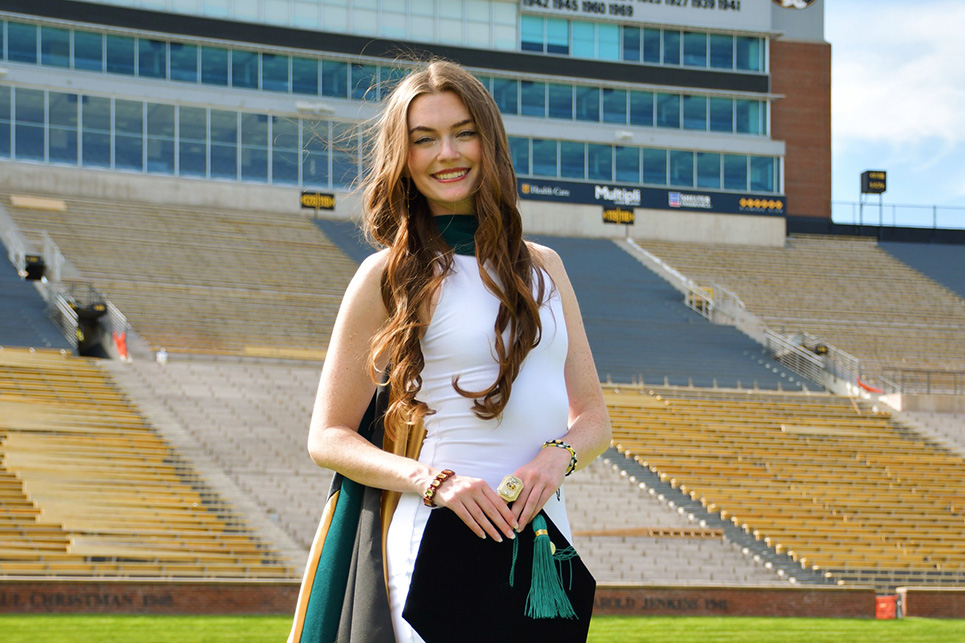
Ana Rembecki arrived at Mizzou as a transfer student eager to find her footing. She’s preparing to leave campus as a Doctor of Physical Therapy, shaped by hands-on care, meaningful patient relationships and experiences that pushed her to grow clinically and personally.
A native of Union, Missouri, Rembecki earned an undergraduate degree in biosciences before starting her studies in the Department of Physical Therapy. She will serve as the student speaker for the College of Health Sciences commencement ceremony on Saturday, May 16, in Jesse Auditorium, marking the culmination of her undergraduate and doctoral studies at Mizzou.
Rembecki transitioned into the rigor of doctoral coursework weeks after completing her bachelor’s degree, quickly immersing herself in hands-on learning.
“All of a sudden, I’m in the anatomy lab five hours a day,” she said. “I would go straight from the lab to grab lunch in the student center, and then I’d go to work in the Student Success Center smelling like formaldehyde. I’d be like, ‘I don’t think prospective students want to see me right now.’ ”
That busy schedule set the tone for a demanding program that helped Rembecki grow through experiential learning and intensive coursework. She remained active on campus, serving as a graduate assistant in the Transfer Center while continuing to seek opportunities to work directly with people.
“Reflecting on it now, I can really see all the sacrifices that Mizzou has made for me,” she said. “Ever since I’ve stepped foot on campus, the community has really been here for me and my fellow students.”
Those sacrifices were on display in the PhysZOU pro bono clinic, where Rembecki and her classmates provided care to community members while gaining invaluable clinical experience.
“People will drive hours to get to our pro bono clinic — just to help us learn,” she said. “It’s incredible to see that sacrifice, and I hope to emulate that dedication and commitment in my career.”
Rembecki’s commitment to patient-centered care extended beyond her clinical work. She volunteered with Special Olympics, worked with older adults in community-based exercise programs and helped a cancer patient remain active and mobile through home exercises. Those experiences reinforced her interest in building strong therapeutic relationships and addressing the whole person rather than just a diagnosis.
Faculty mentorship played a central role throughout her journey, especially during emotionally challenging clinical rotations. Rembecki credits multiple instructors for supporting her academically while also modeling compassion in practice.
“They truly care about our well-being and education,” she said. “I could ask them to do anything for me, and they would do it.”
That support was meaningful during rotations that exposed her to high-acuity environments, including a placement in the University Hospital Emergency Room. Observing how providers connected with patients and families during difficult moments helped shape her own approach to care.
“I’ve seen providers cry with patients,” she said. “I think that’s a powerful thing to show as a health care provider versus just trying to keep all of those emotions bottled up.”
In addition to her clinical training, Rembecki served as a sports medicine student assistant with Mizzou football. That role enabled her to travel with the team to the Cotton Bowl in 2023 and be on the field as the Tigers notched a big win over Ohio State. She also held a leadership role as outreach director for the Student Physical Therapy Organization, where she worked with prospective students interested in the profession.
After graduation, Rembecki will begin her career in outpatient orthopedics in Chicago. While she plans to build a broad foundation early in her career, she remains open to specializing in sports-related care or home health. Longer term, she hopes to return to Missouri and contribute to rural health care.
As she prepares to take the commencement stage, Rembecki hopes her message reflects the values that guided her through the program.
“Don’t be afraid to be uncomfortable,” she said. “Don’t be afraid to show emotions with patients.”