Jan. 22, 2026
Story by Ryan Gauthier, rjgauthier@health.missouri.edu
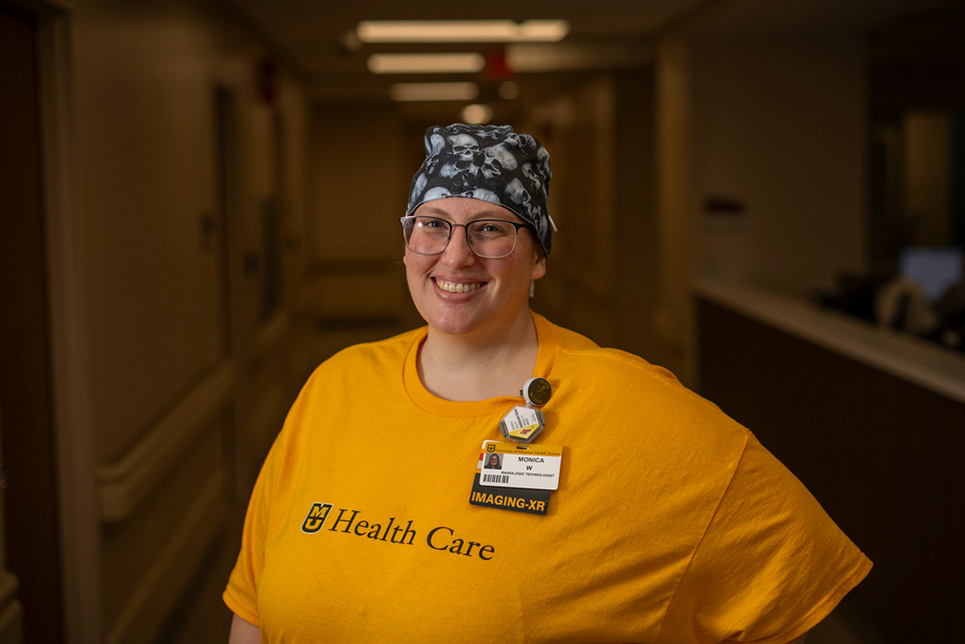
Before she ever stepped into an X-ray room, Monica Wolff was studying skeletons. As a biological anthropology major at Mizzou, she spent hours in the lab examining bones, learning to recognize the subtle signs of age, injury and disease etched into the human body.
“I was just always interested in biological anthropology,” she said. “I loved studying bones and how the body works.”
Wolff spent six years working in housekeeping at MU Health Care after completing her studies. The work was rewarding, but Wolff said she missed the academic interests she had developed in college. That background helped guide her back to school at Mizzou — this time with the radiography program in the College of Health Sciences’ Department of Clinical and Diagnostic Sciences.
“I realized I liked anatomy and working with people,” she said. “The radiography program brought those two interests together for me.”
At 35, she enrolled as a full-time student. She was able to complete clinical rotations while continuing to work weekends at University Hospital in telecommunications.
“I connected with [Radiography Program Director] Carla Allen, got with an advisor and figured out my prerequisites,” she said. “I only needed a handful of classes before starting the program, and it all just flew by.”
Since graduating in spring 2024 with a bachelor’s degree in radiography, Wolff has transitioned into a role as a radiologic technologist at University Hospital. She performs a variety of imaging studies and rotates through outpatient clinics, operating rooms and emergency departments.
The program was challenging, but Wolff said she appreciated the support from faculty and her classmates, many of whom also followed nontraditional paths. She enjoyed the hands-on learning that came with clinical work, especially in trauma and surgical settings.
“No day is ever the same,” she said. “Even if you’re in the same clinic, there’s going to be something different.”
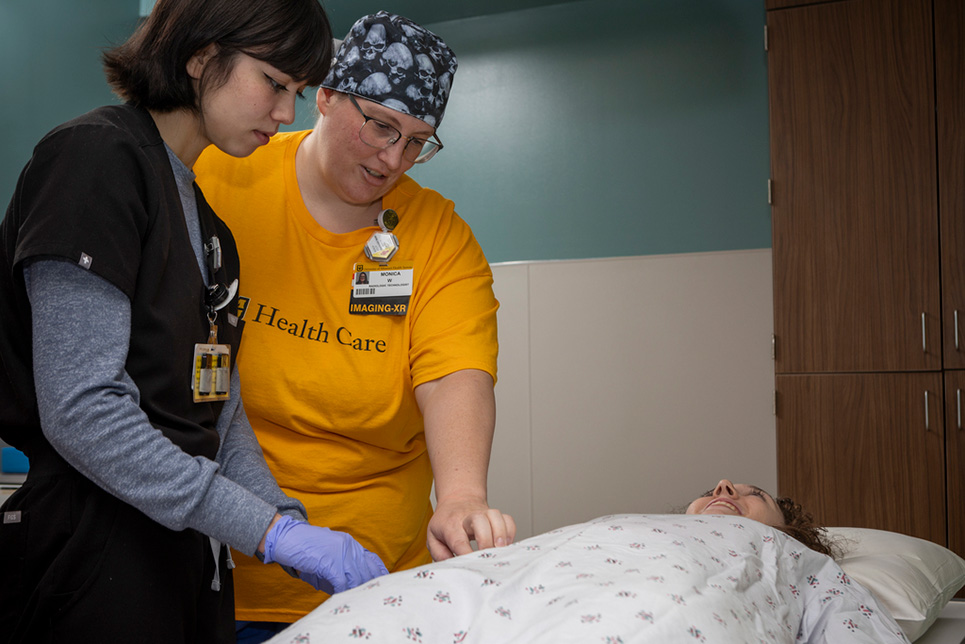
Wolff said she enjoys being able to see patients more than once and track their progress over time.
“It’s probably one of the very few jobs in health care where you might be able to actually follow a patient through their recovery,” she said.
Wolff also appreciates the level of autonomy in the field and the creative problem-solving it requires. Some of the work involves improvisation, especially with patients who have nonstandard anatomy or difficulty communicating.
“You can’t always go by the book,” she said. “That makes it challenging, but it’s nice because it’s also always different. You’re not going to just take the same X-rays every day.”
Wolff said she is considering pursuing a master’s degree so she can teach radiography courses in the future. She credits the radiography program at Mizzou for opening the door to new professional opportunities.
“Nobody should be afraid to start a new career later in life,” she said. “It’s so rewarding, and it was absolutely worth all the hard work.”