February 12, 2026
Story by Cheri Ghan, ghanc@health.missouri.edu
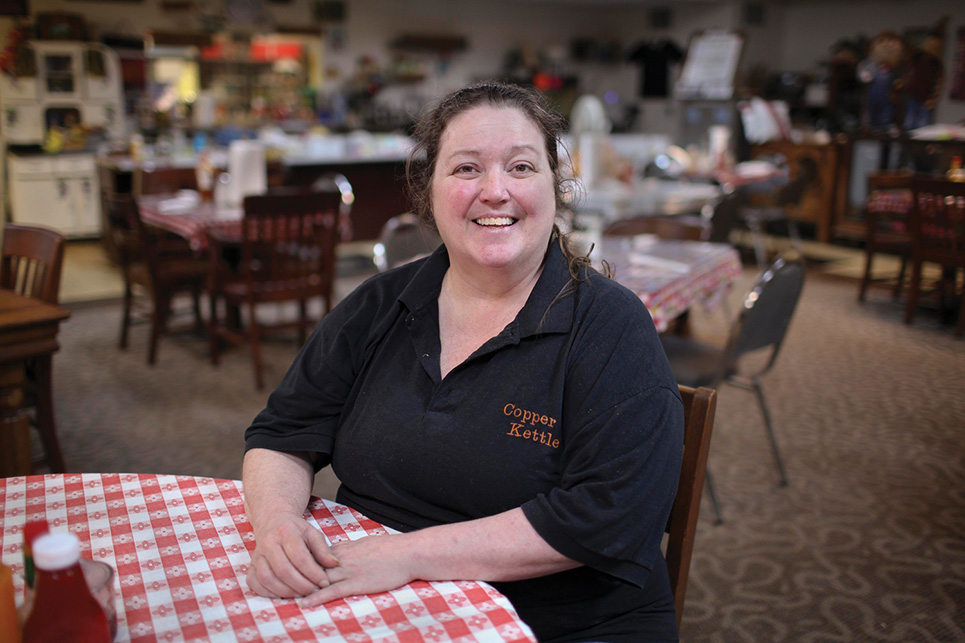
Cindy Downing can tell you exactly where each customer sits at the Copper Kettle, the restaurant she has owned and operated in Ashland, Missouri, for more than two decades. When someone unwittingly takes the seat of a regular customer who will soon be visiting, she gently asks them to move to another table. Her customers are like an extended family.
Given her dedication to customer service, it’s natural that Downing also values her talents in the kitchen. Whether she’s preparing her signature fried catfish, chicken or homemade pies, her gift for grub has always been a prized possession.
That gift was nearly stolen by a devastating stroke in January 2014. But thanks to faculty and students at the Tiger OT clinic in the Mizzou College of Health Sciences, she can still serve up those delicious dishes — and more.
‘Am I going to die?’
It was a cold January day when Downing was rushed to University Hospital in an ambulance. Reeling from the recent losses of her dad and a dear uncle, she asked a nurse in the emergency room a pointed question: “Am I going to die?”
The response was initially stark, but it gave Downing the hope she needed: “Yeah, you are,” the nurse replied calmly. “Just not today.”
Doctors determined she had a blood clot, not a brain bleed, and administered tissue-type plasminogen activator, a clot-busting drug primarily used to treat ischemic stroke. The drug worked, but Downing was severely affected on her left side. She found herself struggling to use her left arm or hand — a challenge as she is left-handed — and she couldn’t walk well.
An attending physician told Downing she would recover but to only expect progress for about six months. She was discharged to Rusk Rehabilitation Hospital and eventually to an outpatient physical therapy clinic in Ashland.
After six months of therapy, her insurance-approved sessions were exhausted. A Mizzou Department of Physical Therapy student doing rotations at the clinic asked a faculty member if there was any way they could help Downing. While he agreed Cindy had met PT goals, he felt like she had other healing needs to get her pre-stroke life back on track.
After discussing how occupational therapy could aid her recovery, Downing started rehab sessions through the Tiger OT clinic in fall 2014. Her experiences would be marked by innovative care, great strides in her abilities to perform important tasks and the launch of research with the potential to help other stroke survivors in their recovery. Downing also progressed far beyond the original six-month limit predicted by the attending physician, something she is still proud of today.
Over easy
Whitney Henderson, an associate clinical professor in the Department of Occupational Therapy at the University of Missouri, was the first faculty member to work with Downing. Her goals were varied, Henderson said, including everything from writing down orders to braiding her hair.
“She always had ideas for daily tasks she could use for goals,” Henderson said.
Downing fully embraced each new challenge, working alongside student clinicians who were equally invested in her recovery.
“They would get their heads together and come up with things,” she said. “The students had no preconceived notions about what to do. They wanted to try all the things, and I’m game for all the things. They would ask me if I was up for a new technique, and I would say, ‘Yes! If you’ve got something new you learned in class last week, what’s it going to hurt to try it?’ ”
Braiding her long hair topped the list, as she needed to keep it out of the way while cooking. After they had success with braiding, they moved on to flipping an egg, a task Downing performs dozens of times a day.
“I did get to a place where I could flip an egg with my left hand and not break the yolk,” she said. “We flipped eggs — those girls ate so many eggs — and we flipped cookies. We flipped lots of things.”
Chopping vegetables was more challenging as Downing struggled to grasp the knife with her left hand while performing a downward chopping motion. When the student clinicians suggested an adapted knife, Downing ordered multiple.
A similar challenge surfaced when it came time to craft her homemade pie crusts: The same downward pressure that evaded her with chopping was necessary to roll out the crusts using a rolling pin. Typical OT creativity came into play as one of the students created an adapted tool using a PVC pipe. One end of a T-shaped PVC pipe slipped over the left handle of the rolling pin, and the other side stuck up vertically, allowing a grip motion Downing was able to make. For just 37 cents, Downing was back to baking pies.
With each met goal, Downing felt her brain and left arm working together, teaching each other how to get back to some semblance of normal.
“Every time my arm wanted to do something, I had to let it,” she said. “It was ready to learn something new. When I did it, I felt it all the way to my brain, and my brain said, ‘You did it!’ I had lots of those moments in clinic.”
Henderson said Downing’s positive attitude and grit played major roles in her rehab successes, praising her efforts both within the walls of Tiger OT and at home with exercises planned by the team.
“Cindy was motivated and willing to try anything the students or I asked of her,” Henderson said. “She worked extremely hard and liked being pushed. She was also cheerful and had a great desire to help the students learn by sharing her life, medical, and therapy experiences.”
BIG answers to big questions
In addition to completing her therapy, Downing participated in research projects to help others in similar situations.
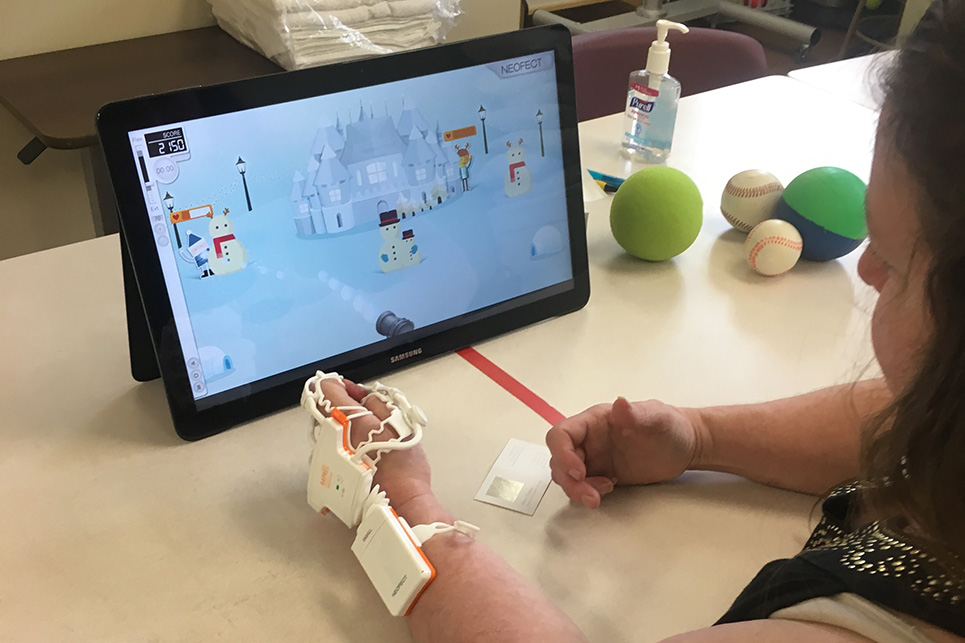
One study by Henderson and Rachel Wolpert, associate professor and associate chair for research in the Department of Occupational Therapy, looked at using Lee Silvermann Voice Treatment-BIG therapy (LSVT-BIG) on stroke patients. LSVT-BIG is an intensive movement intervention shown to be effective in improving gait, balance and upper extremity function in people who have Parkinson’s disease and other neurological conditions.
Henderson and Wolpert worked with Downing to determine whether LSVT-BIG could be an effective intervention for stroke survivors.
“Cindy was an ideal first research participant because we were foraging into a new area of research,” Wolpert said. “She tolerated all the bumps that come along with trying something new. She gave us great feedback, and I went back to her multiple times when I was working on the larger studies later. She was able to tell me what might work better for other people and what barriers I might expect.”
A case study on Downing by Wolpert and Henderson was the impetus for a $50,000 grant Wolpert received from the American Occupational Therapy Foundation in 2018. That led to a Roger S. Williams Research Grant from the College of Health Sciences that Wolpert is using to further that research.
“Cindy made incredible improvements over a short period of time,” Wolpert said. “For many individuals post-stroke, it takes three to four times longer to see the gains she made in only a month. It also hinted that we were on the right track with this intervention and population.”
Over the course of 12 semesters, Downing worked with Henderson, Wolpert and 25 student clinicians. While she was sad to see the student clinicians go, she valued the different perspectives each person brought to her care.
“I was used to changing high school students who worked for me in the restaurant, so I understood this aspect,” Downing said. “It was sad to see them go, but fresh eyes, somebody who had maybe gleaned something different from their class and textbooks meant I would be learning something in a different way, and that was so good.”
As for Tiger OT, Downing is a fan who gives it a five-star review. Henderson recalled a particular quote from her longtime patient that helped make a big difference for her.
“I was a horrible counter when doing repetitions, and I would say, ‘I can’t remember what number we are on, so let’s do two more’,” Henderson said. “Cindy would always say, ‘One more won’t hurt me, and one less won’t help me.’ That’s true!”