Named a Best Occupational Therapy Program 2026
In the latest graduate school rankings, U.S. News and World Report ranked Mizzou’s Occupational Therapy program in the top 11% in the nation.
Overview
The continued high demand for occupational therapists (OTs) and increasing accreditation requirements prompted the American Occupational Therapy Association to vote in support of entry-level education for OTs at the doctoral level, in addition to the traditional master’s degree. We are confident in the high quality of education within our OTD degree to prepare our graduates for a long and successful career in occupational therapy.
Careers in OT
The median pay for occupational therapists is $98,340 per year, and more than 10,000 job openings are projected each year.
Learn more
Already interested? Want to talk to someone from the OT department who can answer your questions?
Coursework
Students will complete 105 credit hours over three years in a full-time cohort model curriculum. The first year and a half will be completed on-site. The spring semester of the second year involves 24 weeks of Level II fieldwork at sites located across Missouri and throughout the United States. The fall semester of the third year is entirely online, and the spring semester of that final year involves 14 weeks of doctoral capstone experience at sites located across Missouri and throughout the United States. View recent doctoral capstone projects.
Students will also be required to pass a national certification exam administered by the National Board of Certification in Occupational Therapy (NBCOT) in order to gain entry into the profession and obtain licensure. Students will have the ability to customize their educational plans through unique combinations of fieldwork and doctoral capstone experiences.
Curriculum
See required courses and a semester-by-semester plan.
Admission and application
Learn more about prerequisite courses, GPA requirements and more about the application process.
Clinical experience
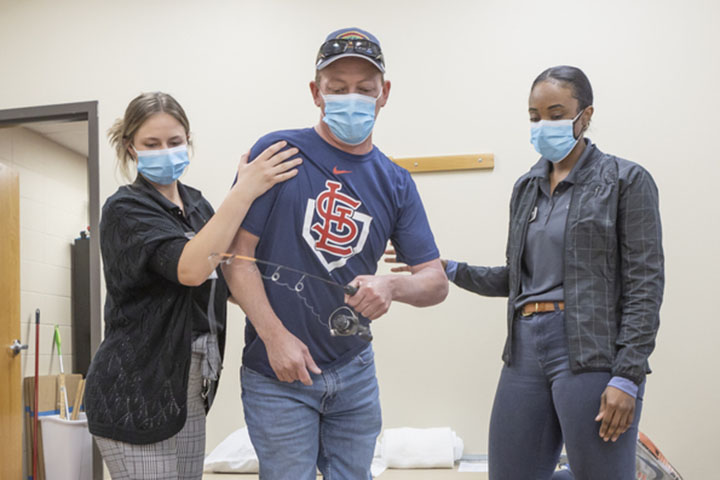
Students choose from more than 300 fieldwork sites across the nation to complete their Level I and II field placements and a doctoral capstone.
Cost and aid
The Occupational Therapy department follows the University of Missouri’s Professional tuition and fees for the Occupational Therapy Doctorate program.
OTD Program Outcomes
| Graduation Year | Students Entering | Students Who Withdrew for Reasons Other Than Academic Performance | Students Graduating On Time | *Graduation Rate |
|---|---|---|---|---|
| 2025 | 44 | 1 | 42 | 98% |
| 2024 | 45 | 1 | 44 | 100% |
| Total | 89 | 2 | 86 | 99% |
performance.
Class of 2024 was our first graduating cohort for the OTD program. Updated numbers will be provided as future cohorts graduate.
National Board for Certification in Occupational Therapy (NBCOT) program data results.
Accreditation and credentialing resources
The entry-level occupational therapy doctoral degree program is accredited by the Accreditation Council for Occupational Therapy Education (ACOTE) of the American Occupational Therapy Association (AOTA).

Accreditation Council for Occupational Therapy Education
7501 Wisconsin Avenue, Suite 510E
Bethesda, MD 20814
Phone: (301) 652-6611
Web address: acoteonline.org
Graduates of the program will be eligible to sit for the national certification examination for the occupational therapist administered by the National Board for Certification in Occupational Therapy Inc.
National Board for Certification in Occupational Therapy
1 Bank Street, Suite 300
Gaithersburg, MD 20878
Phone: (301) 990-7979
Fax: (301) 869-8492
After successful completion of this exam, the individual will be an Occupational Therapist, Registered (OTR). In addition, all states require licensure in order to practice; however, state licenses are usually based on the results of the NBCOT Certification Examination. Note that a felony conviction may affect a graduate’s ability to sit for the NBCOT certification examination or attain state licensure. Students must complete 24 weeks of Level II fieldwork and a 14-week doctoral capstone experience within 24 months following completion of the didactic portion of the program.